
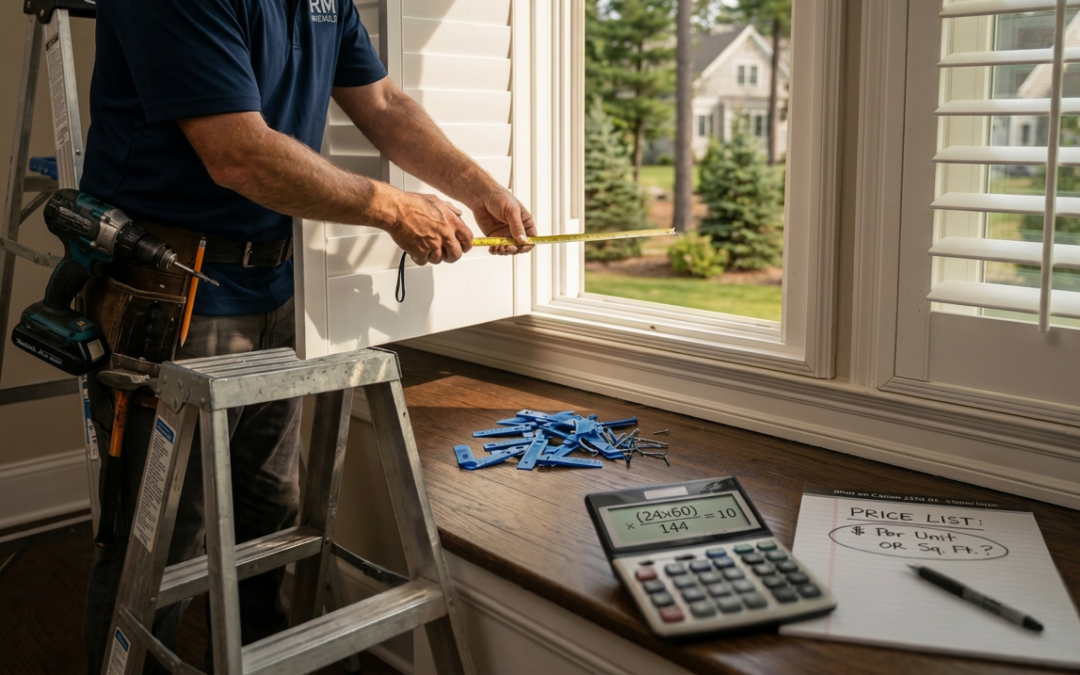
Ask 10 installers across the country to price the exact same job, and you’ll get 10 different numbers.
When I started two decades ago, I asked everyone for guidance. Nobody could give me a straight answer. And FYI, I’m not going to give you one either.
So here’s the honest map (not the answer).
The Pricing Method Keeps Changing Under Your Feet
Back in 2006, my first number was $15 a shade. That’s what the retailer paid. Per unit. Pick it up at the store, drive it to the jobsite, install it, get paid.
Two or three an hour and I thought I was rich. Two weeks into the industry, I realized I wasn’t. I just didn’t know what I didn’t know yet.
Then I worked for Lowe’s, and the whole system changed. Now they paid by linear foot. Same hands, same skill, completely different math.
Then interior shutters showed up and moved the goalposts again. Now it’s square footage. Width times height, divide by 144, there’s your price per square foot.
And here’s where it got interesting: because square footage isn’t even the same number everywhere.
Same Product, Different Price
I built my business in New England. Up there, windows have wood casing. That means direct mount, and direct mount is one of the meanest ways to hang a shutter.
You’re screwing each panel straight to the jamb, and almost no window is truly square. You set the first panel with nothing to reference.
Set the second, go to close it, and the panels don’t line up. Now you’re shimming and adjusting. Multiply that across a whole house and you’ve burned three or four hours you never planned for.
Go south or west and a lot of those windows are just a sheetrock opening. No trim. Dealers order the panels in a frame, drop the frame in, and the overlap hides every imperfection.
Faster installation. Cleaner look. But it pays the installer less.
Same product. Same square footage. Completely different amount of work.
That’s the whole lesson, right there. The number was never really about the number. It’s about the labor hiding underneath it. The labor nobody warns you about until you’re standing in it.
Like the day I took a three-window job that should’ve been quick. Except there was nothing solid in the ceiling to hold my brackets.
So there I am, up on the ladder, engineering toggles and improvising anchors just to make it work. At $15 a unit, I lost money on three windows. On an hourly rate, I’d have been fine.
But here’s the trap: you can’t flip back and forth. Hourly today, per unit tomorrow. That’s how you confuse dealers and lose their trust. You pick a system, build a price list, and stick to it, so nobody gets surprised.
Trust me, no one likes a surprise. Especially with a bill.
Goodreads Book Giveaway

Nobody Told Me That
by Roger Magalhães
Giveaway ends September 09, 2026.
See the giveaway details at Goodreads.
What Actually Belongs on Your Price List
So after 20 years of getting this wrong before I got it right, here’s what I wish someone had handed me on day one.
- The hidden labor, not just the install: A drapery isn’t done when the rod’s on the wall. You’ve still got to steam it and dress it so it hangs right. That time is real, and it’s on top of your linear-foot rate. Charge for it.
- Motorization is its own skill: You’re not just hanging a shade. You’re programming it, syncing remotes, and troubleshooting when something won’t talk to something else. That’s skilled time. It belongs on the list as its own category.
- Exterior means a helper: You’re almost never installing those solo. Build the second set of hands into the price, because you’re paying them whether the job accounts for it or not.
- The extras that eat your day: High-ladder work above 8 or 10 feet. Scaffolding or a lift. Drilling into concrete. Condos and high-rises. Pickups from a workroom or warehouse to the job site. All of it is your time and your equipment put to use. And all of it should be charged for.
- Your overhead sets your floor: $15 a unit sounds amazing, until you realize you’d have to install thousands of hard treatments just to break even. So do yourself a favor and open QuickBooks. Add up what it costs to keep your doors open, including your own salary and your vacation time. Then work backward to what a job has to earn. That’s your floor. Everything above it is profit.
The Part That Only Shows Up With Time
As your expertise and reputation grow, you earn the right to charge more. That’s not arrogance. That’s the market catching up to what you’re actually worth.
So build a price list that reflects two things: fairness and your experience. Some jobs will land at a higher dollar-per-hour than others. That’s just the game.
Don’t chase every job to win it, because chase them all and the only reputation you’ll build is the nickel-and-dime guy. And trust me—that’s a hard label to shake.
On the flip side, once you’re more expensive than your competition, don’t take it personally when you don’t get every job. It isn’t personal.
Dealers and workrooms switch between installers based on rates and expertise all the time. That’s fair to them, too.
I used to be offended by that in my early years. Today I see it the other way around: I earned my badge to be the guy they only call for the most complex projects. That’s a reputation only time can build.
The real answer was never a magic number. It’s your number.
Roger Magalhães
Founder, Shades In Place & Trading Up Consulting
Host, No Strings Attached Podcast
P.S. — How do you price your work? Drop a comment below and tell me. I’m always curious how the rest of my peers do it—that’s how I learned in the first place!
Want more real talk on how to price your installation jobs, stop losing money on hidden labor, and build a business that actually earns what you’re worth in the window treatment trade?
Tune in to my podcast No Strings Attached for honest stories from the field—how to set a firm price list, handle complex jobs without getting burned, and command respect as a true trade professional.