
Most of us (myself included) aren’t thrilled about paying insurance premiums. Add up what you’ve spent over the years and it’ll make you want to “self-insure” with sheer optimism. But the one time something goes sideways, you’re grateful you’re covered.
That peace of mind is the whole point.
In the window treatment industry, there’s a similar “premium” that protects your profit, your timeline, and your reputation:
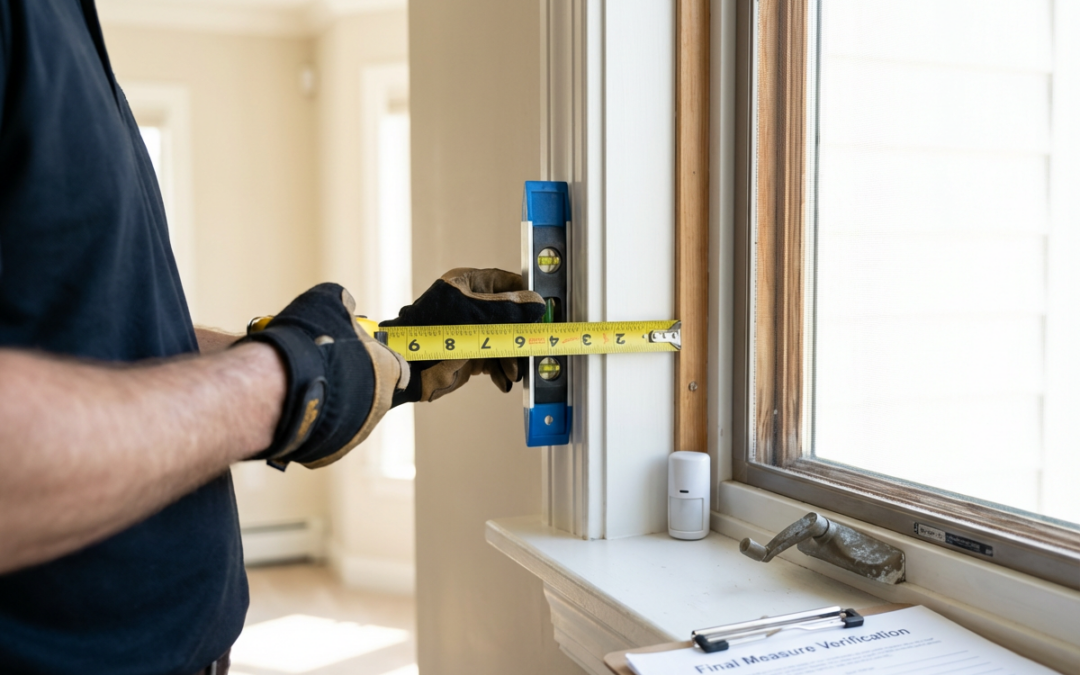
Before any non-returnable custom order is placed, the installer should confirm the measurements and see the jobsite.
This isn’t about ego or trust. It’s about reality: window treatments are not just width and height—they’re application, clearance, projection, and install conditions. (And yes, the weird window in the house always waits until install day to reveal itself.)
This article is for window treatment professionals—designers, dealers, workrooms, and installers—because measurement ownership affects everyone. Designers and workrooms often take initial measurements to get a quote moving (totally normal).
Homeowners sometimes insist they can measure themselves (also common). But when it’s time to place a custom window treatment order that can’t be returned, someone has to be responsible for the final call.
And in a clean workflow, that “someone” is the installer, because the installer is the one who has to make it work in the real world.
The Cost of Skipping Installer-Confirmed Measurements
I hear the same lines from smart, experienced people:
- “I know what I’m doing.”
- “I’ve been doing this for years.”
- “It’ll slow down the process.”
And yet, when I arrive for installs, the same preventable issues show up again and again:
- Openings measured correctly… but the application is wrong
- The product fits on paper, but the window depth/clearance doesn’t support it
- Trim, projections, or obstructions weren’t accounted for
- Wrong returns, wrong valance projection, missing brackets/spacers
- A “simple” window turns out to be out-of-square, out-of-level, or just plain weird
The result is always the same: delays, remakes, uncomfortable conversations, and someone eating the cost.
If you’re a dealer, designer, or workroom, that cost shows up as margin erosion and client frustration.
If you’re the installer, it shows up as wasted trips, blame, and schedule chaos.
Either way, it’s expensive.
Real-World Example: “I’m a Carpenter. I Can Read a Tape.”
Let me prove it with a story from my second year in business.
A client—professional carpenter, remodeling his own home—ordered vertical blinds from a factory-direct outlet. When the product arrived, he called me to install.
I asked who measured. He said, “I did. I’m a carpenter. I know how to read a tape measure.”
My reply was simple:
“There’s more than width and height involved when specifying window treatments. If I arrive and the blinds can’t be installed, you still owe me for the visit.”
Sure enough, none of his eight blinds fit.
The windows weren’t deep enough to accommodate the product, and the valance projection was wrong. He was furious. The situation was uncomfortable. And he still had to pay for my time.
That’s what happens when measurements are treated like a formality instead of a responsibility.
The Designer Shortcut That Eventually Got Banned
Another example came from one of my regular installation accounts.
A decorator insisted on ordering without having the installer confirm measurements. Her logic: it slowed the process and gave homeowners a chance to second-guess the sale.
I understand the fear. But here’s the reality: mistakes cost more time than an installer visit ever will.
Problems happened often enough that the account eventually made installer-confirmed measurements mandatory before every order.
That wasn’t a “policy update.” That was an expensive lesson getting turned into a workflow.
What “Confirm Measurements” Really Means (It’s Not Just Re-Reading the Tape)
If you want to avoid remakes and protect your margins, “confirm measurements” has to mean more than repeating the same width and height.
Installer-confirmed measurements should include a quick jobsite reality check—because the installer is confirming the specification, not just the numbers:
- Mount type: inside mount vs. outside mount (and whether it still makes sense)
- Window depth and clearance: especially for roller shades, verticals, shutters, and motorized treatments
- Trim and projection issues: casing depth, returns, valance projection, crown/baseboard conflicts
- Obstructions: cranks, handles, alarms, sensors, radiators, furniture placement
- Level and square: out-of-square openings change deductions and expectations
- Access and install conditions: ladder setup, height, safety, parking/building rules
- Hardware and parts: extension brackets, spacers, hold-downs, returns, specialty fasteners
If you’d like a deeper dive into everything to consider when measuring, check out our online classes here.
This is where experience pays for itself—quietly, consistently, and usually before anyone else even knows there was a problem.
How This Works in the Real World (Without Slowing Everything Down)
The process doesn’t have to look the same on every job. What matters is the outcome:
Installer sign-off before ordering.
Here are a few common ways pros make it work:
- Installer joins the first appointment with the designer/dealer and measures on the spot.
- Designer/workroom gathers initial info for quoting, then the installer confirms measurements and jobsite conditions before the order is placed.
- The homeowner provides rough measurements for budgeting, then the installer verifies everything once the project is approved.
Different paths, same rule: don’t place the order until the installer has eyes on the opening.
How to Explain This to Clients (Without Sounding Salesy)
You don’t need to “upsell” measurement confirmation. Just frame it as standard professional process.
Try language like:
- “Before we place a custom order, our installer verifies the measurements and the jobsite conditions.”
- “Custom window treatments aren’t returnable, so we confirm everything before we order.”
- “This step prevents delays, remakes, and surprises on install day.”
Clients don’t need a lecture. They need confidence, and a process that feels normal.
Bottom Line: Confirmed Measurements Protect Everyone
Yes, having the installer confirm measurements can add a step. Sometimes it’s a second visit. Sometimes it’s the installer joining the first visit. Either way, it’s cheaper than a remake.
If you make measurements a non-negotiable part of your workflow, especially when numbers come from a designer, workroom, or homeowner, you’ll protect the project, the relationship, and the profit.
Because in this business, the most expensive measurement is the one you didn’t verify.
— Roger Magalhaes
Founder of Shades In Place & Trading Up Consulting
Want more real-world installer stories, measurement pitfalls, and workflow fixes from window covering pros?
Tune in to our podcast No Strings Attached for honest lessons and practical tips from experienced installers, designers, and dealers who’ve faced the same challenges.